Features:
Our gatherings could be so much better
We say we welcome innovation, but our spaces preserve power
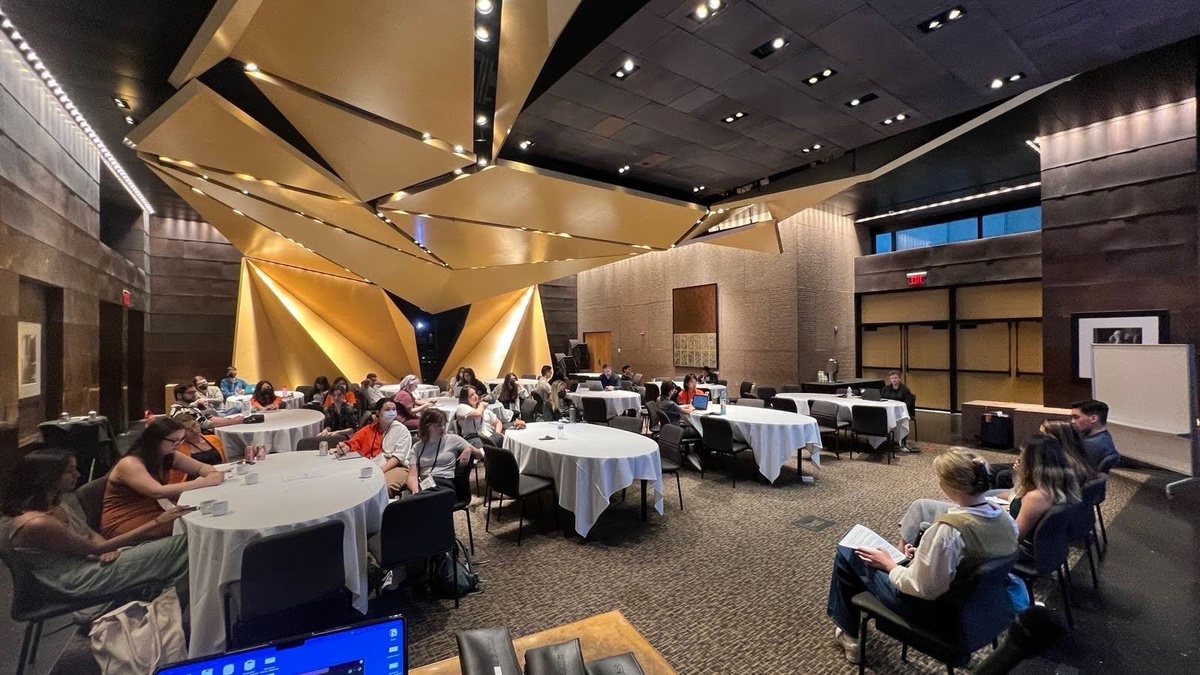
A session during SRCCON 2024, where a panel and room of early career journalists and technologists shared their hopes and challenges in the industry. (Madison Karas)
We attend a lot of journalism conferences. We’ve organized sessions, facilitated workshops, spoken on and moderated panels. Between us, we've probably accumulated more conference lanyards than either of us cares to count.
We attend because we believe in showing up to create a better future of journalism. But there's a problem, no matter where we go: we so often see the same faces again and again. We are those same faces.
The same speakers present the same slides about the same problems to the same audience, year after year. New or outside voices rarely make it into these conversations, because who counts as a “key” person gets defined by the group itself. The validation is circular, and that's exactly the problem.
This isn't a complaint about any particular event. It's an observation about a pattern that we’re all participating in: preserving podiums in industry spaces for familiar faces instead of welcoming new voices. Year after year, journalism gatherings can feel like a cruise ship tour to celebrate the same winners in different settings, rather than fresh spaces to explore fresh ideas.
It’s a dangerous cycle. We end up pushing out the ones we often claim we praise: the people from less familiar spaces figuring out what actually works. Instead, we default to theatrics of glamorizing established voices and, in turn, keep failing to solve the same problems we keep showing up to discuss: how to reach communities that traditional newsrooms have ignored, provide information services people genuinely need, and build sustainable models that don't depend on foundation cycles.
Journalism is contracting. Resources are increasingly scarce. And when resources become even more scarce, the natural instinct is to protect what remains, to close doors, limit access, keep something going.
We think this response is exactly backwards.
The closed-loop problem
Our events should extend the first invitation to those propelling innovation. But to make that widespread, we first have to confront the systemic confirmation bias and its cost: When we default to the same speakers, the same networks, the same comfortable hierarchies, we cut ourselves off from exactly the people and ideas we need most. Every gathering designed around insider access is a missed opportunity to discover what's actually working somewhere we weren't looking.
When the same people keep talking to each other, ideas calcify. Solutions that failed in 2019 get repackaged with fresh trends, like the AI or creator economy buzzwords, and presented as novel thinking in 2026. Allegiance to established figures becomes more important than whether someone actually has something new to contribute, and tolerance for those with differing thinking or experiences diminishes (and eventually, those folks leave the industry.)
We all have been in rooms where the people doing the most interesting work on the ground (often organizers, technologists, researchers, small-newsroom founders) are absent from the main stage while executives give speeches about transformation they're not actually implementing. At a recent civic journalism conference, a local events creator told us they felt “talked at” by executives instead of conversed with. They’d attended to learn about journalism and share their work with journalists after finding the conference on a public events calendar. Instead, they felt shut out.
This is just one of many examples. Everyone is trying to preserve positioning in times of extreme constraint. But when gatherings don’t do what they’re supposed to do — invite and share new perspectives and ideas — there are consequences. This matters because journalism's relevance crisis won't be solved by the same approaches that created it.
And when new entrants arrive to find an industry that is dishonest about its opportunities - when they occur at private side-events rather than center stage - we create a culture that will never truly welcome genuine innovation.
What we're missing
The thing is, there's so much happening outside our usual circles.
Some gatherings already break this pattern. Perspectives, a volunteer side project founded in 2022 by Andrew Losowsky, Ariel Zirulnick and Robin Kwong, brings in experts from other fields who are navigating the same challenges as journalists, introducing tactics and strategies from elsewhere that we can bring back to our own work. It's a great idea: stop talking only to ourselves.
There's also small shifts at traditional events: More unconference sessions allow attendees to influence the conference agenda organically, and more spaces are hosting professional development opportunities for marginalized and early career folks. These support the people who will actually be in the seat to lead the industry's future to participate.
These shifts get at the questions facing the industry about our purpose and professionalism: At a recent conference, a librarian pointed out to one of us that everything we were describing as journalism innovation (documenting, preserving memory, making information accessible) is what librarians do every day. They just don't call it journalism. Wikipedia editors have maintained the world's primary information commons for decades while many of us dismissed them as non-journalists. PTA parents launch local news operations that outperform legacy outlets. Mutual aid organizers build information networks that reach people newsrooms never could.
These people aren't waiting for our industry's permission. They're already doing the work of informing communities, often more effectively than we are. Instead of gathering separately, we could be using our spaces to figure out how to integrate and work together.
The automatic choices
None of this happens because anyone is malicious. It happens because it's easier, and when there's not enough funding, people or positions to go around, every repeat mic grab feels justified.
Continuing to invite the same people, create the same conference agenda or rinse-and-repeat an awards ceremony are convenient choices in the short term. But they accumulate into a closed loop that makes our industry smaller and less relevant with each iteration.
The alternative isn't complicated, but it takes work. It requires noticing when we're defaulting to the familiar, and asking whether that default is actually serving anyone beyond the people already in the room.
From there, we have to do what journalists do best: chase answers to our questions. And then, redesign our spaces to make our work more exploratory and reflective of real experiences.
We want to start doing that together. This is the first piece of coming conversations about how we shape and design gatherings in journalism, and how we can improve them to better support innovation in the industry times of crisis. Have thoughts? Get in touch with us at better-gatherings@gazzetta.xyz or join us for the OpenNews Community call on Feb 26 to talk more.
Credits
-
Patrick Boehler
Patrick Boehler has accumulated more conference lanyards than he'd like to admit. He runs Gazzetta, a media research lab studying how people access information in restrictive environments, and writes the re:filtered newsletter. Before that, he spent years as a reporter, editor, and newsroom manager in Asia and Europe. He lives in Brooklyn and is trying to attend fewer panels.
-
 Madison Karas
Madison Karas is the Lead for Service Design at Gazzetta. She works on product and research initiatives for independent media organizations and has spent a lot of time in startups and too much time at conferences. She is exploring how service design, cooperative models, and more robust contribution systems can build a better, more intentional future for journalism producers and consumers.