Features:
What does peer support in journalism look like: Insights from U.S. and international experts
Establishing a peer support network or becoming a peer supporter is not as complicated as it may sound
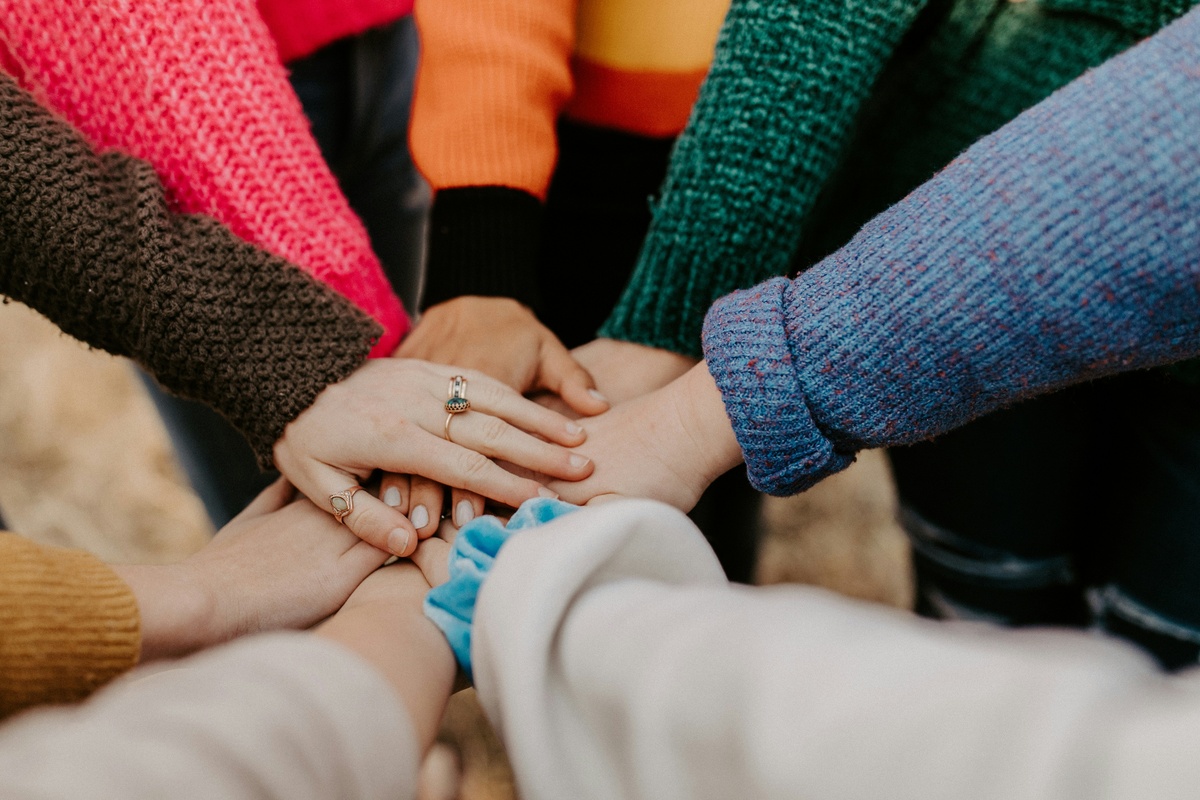
Putting our hands together for peer support (Photo by Hannah Busing via Unsplash)
Journalists are increasingly facing online abuse and psychological strain, yet many lack consistent support structures, like peer support networks.
I was excited to moderate a panel of experts and journalist peer supporters during a recent panel at this year’s Mental Health Journalism Summit, organized by The Self-Investigation and sponsored by OpenNews. (A recording of the panel discussion and others are available via the Self-Investigation Academy.)
The panelists framed peer support as a critical tool for psychological well-being, safety and professional sustainability in our industry. They also provided concrete examples of how newsrooms can establish peer support networks.
In simple terms, peer support is emotional and psychological support outside of a clinical context. This support is rooted in understanding, trust and accessibility with a peer who might share a profession, an identity or a lived experience.
A recent exploratory report of the peer support landscape in journalism found that journalists facing job stressors mostly prefer to seek support from other journalists, rather than from friends, family or even clinicians. The report, “The Power of Peer Support,” was published by PEN America in April 2024.
The need for peer support grows as journalists work in increasingly restrictive or hostile environments. Reporters face shrinking press freedoms, heightened surveillance, online harassment, legal intimidation, and political or social retaliation, all of which add to the emotional and psychological burdens of their work.
Isolation has also deepened for many journalists as newsrooms shrink, colleagues disperse, and many shift to freelance or remote roles without institutional support. In these conditions, the simple act of comparing notes with trusted peers becomes not just helpful but essential.
“The more restrictive the environment is, the more critical it is to have peer support so that you can actually continue doing the work that you’re doing as safely as possible,” said Jeje Mohamed, co-founder of Aegis Safety Alliance, a collective of women and non-binary media safety experts, during the panel. She’s also one of the authors of “The Power of Peer Support” report.
I’ve summarized some of the key takeaways from our conversation during the panel, including a list of recommendations for establishing and conducting peer support networks.
The landscape of peer support networks in the U.S.
Although they might not be labeled as such, there’s a wide range of peer support networks available to U.S. journalists, including mentorship programs, fellowship programs and professional associations, said Viktorya Vilk, panelist and director of Digital Safety and Free Expression at PEN America, and one of the authors of “The Power of Peer Support” report.
Broadly, these networks fall into two categories:
Organic networks are typically formed organically by groups that have a shared experience or practice. Examples are alumni of a training program who decide to create a WhatsApp group, or journalists who share an identity and start a Slack group.
“They tend to operate super asynchronously, super informally,” Vilk said.
Structured networks, on the other hand, are established deliberately to fulfill a well-defined mission. They’re typically located within an institution such as a newsroom or a nonprofit organization.
They may provide mentorship, professional development or emergency support.
“Despite the fact that there are all these kinds of wealth of offerings, we found, to our surprise, actually, in our report, that journalists are still struggling to get the support they need when they face online abuse and occupational hazards that really impact their psychological health,” Vilk said.
For instance, in newsrooms, journalists were not trusting of the institutional peer support models. They worried about confidentiality, Vilk and her co-authors found. And outside of newsrooms, journalists mostly used organic networks for professional development and not for seeking help for managing online abuse or secondary trauma.
Examples of peer support in practice
The Canadian News Industry Peer Support
In Spring 2025, the Canadian Association of Journalists launched a nationwide volunteer peer-support program open to all journalists regardless of employer.
“We’re available for anyone who feels they need peer support via a Zoom [call], or a phone call or in person too, if we happen to be in the area,” said Jacob Boon, panelist, newsletter editor for The Tyee, and a peer supporter in the Canadian News Industry Peer Support program.
To become a peer supporter, Boon participated in three training sessions with a peer support coach and a psychotherapist.
“I assumed, maybe going in, that a peer supporter needed a diploma or years of training,” Boon said. “And it turns out, you can actually just listen to people.”
Peer supporters are not therapists or case workers, but they learn when to share resources with a journalist who might need professional help. They also learn how to set boundaries to avoid getting too deep in areas that peer supporters may not be able to address. The peer support sessions are set to a maximum of three sessions, each lasting 40 minutes to an hour.
Peer supporters also learn to say when they can’t help the other person, and instead offer someone else or an expert who may be able to help.
Peer supporters don’t need to solve a person’s problem, Boon said. “I sit in a quiet place, and I make sure there’s no distractions, and I just give this person my whole attention and thoughts and spirit for 45 minutes to an hour.”
VitaActiva
VitaActiva is a helpline to aid women journalists and activists facing online violence and gender-based harassment.
The organization grew out of necessity to address trauma, burnout and online gender-based violence, said Luisa Ortiz Pérez, panelist and executive director and co-founder of VitaActiva.
The peer supporters, or responders, follow psychological first aid protocols based on psychologist George S. Everly Jr.’s model.
The organization has three main principles for peer supporters:
Rest relentlessly.
The work of supporters is extremely complex and taxing on the body, Ortiz Pérez said.
“So we militantly take breaks,” she said. “Our responders take up to eight weeks of breaks over the year, and we close the helpline one month for real.”
Become attuned to the notion of anti-solutionism.
Even though a Google search or AI chatbots might offer three steps to solve a problem, it’s important to recognize that it’s not possible to solve everyone’s problem that easily.
“Our motto is we will walk side by side,” Ortiz Pérez said. “We’re a human that walks side by side with you and that is not a simple feat, because we are all extremely connected to the notion of helping others.”
At VitaActiva, the role of responders is to enable the other person to be the main decision maker.
“And that particular shift in the narrative makes all the sense in the world, because as peers, we can say, I hear your pain. I understand where you are. Let’s work together,” Ortiz Pérez said. “And generally, the person leaves the conversation saying, ‘Oh, I know what I’m going to do.’ And that’s a beautiful, beautiful moment.”
Focus on the caller.
The work is about the people who are seeking help, not the responders.
“You’re looking at the other person, you’re understanding what they’re saying, and at the same time, you’re looking at yourself,” Ortiz Pérez said. “We are the reflection of every single person that is going through particular motions, whether it be depression, whether it be trauma, whether it be surveillance.”
So, by being a good mirror, the responder tries to validate the caller. They try to help the caller not to feel alone.
Recommendations
Strengthen existing organic and structured support networks.
If a Slack group has a designated channel for when people are facing online abuse or some kind of really significant mental health issue, assign someone who’s responsible for keeping an eye on the channel. It’s helpful if that individual has some basic training in psychological first aid.
“One option is to maybe partner with organizations that can offer more structured support,” Vilk said.
In structured networks, compensate or provide recognition for support providers.
The goal is to “not to turn it into free labor that usually women, and mostly women of color, are doing within their institutions, but actually to recognize that if you get this certification or training, that is actually a professional skill that you now have,” Vilk said.
Look into establishing a small-group peer support model.
Vilk and her co-authors of the peer support report got the inspiration for the small-group peer support model from other high-stress and high-risk professions.
The idea is to create a small group of six to eight journalists who come together regularly to talk through their experiences with the guidance of a trained facilitator. The group decides when to meet and what to talk about.
“That model, which is not very common yet in the journalism industry, would actually be pretty financially and logistically feasible given what’s facing our industry right now,” Vilk said. “What we’re recommending is an industry-wide model … where journalists from a wide, diverse range of backgrounds could actually access small-group peer support.”
Grant participants confidentiality and anonymity.
It’s important to make peer support groups confidential, and when possible, anonymous.
One reason is self-protection.
“You don’t take it too personally,” said Ortiz Pérez. “You really dissociate or dislocate it from your everyday life, because it can become quite taxing.”
Legal protection is another reason.
“We are in an extremely legalistic and lawyeristic space, and a lot of the work that we do needs to be very openly under something called the Samaritan Law, which is, ‘I help out from the goodness of my heart, and we have no contract or expectations between us,’” Ortiz Pérez said. “That’s why our work is also free.”
It also allows for a more open conversation.
In the Canadian peer support program, according to Boon the conversations are confidential, unless someone is at risk of harming themselves or others. “Having confidentiality is very important to just allow people to actually express themselves and deal with what they’re dealing with,” Boon said.
Look at your existing networks
It may seem like it’s difficult to establish a peer support network, but “if we think about it, we already have several networks in our day-to-day life that are functioning as peer support and maybe we don’t call them that,” said Mohamed, a risk management expert and safety and security advisor.
“What I always keep thinking about is, how can we actually identify the networks that we have in our lives, and how can we utilize these networks and not necessarily create new ones,” Mohamed said. “So if we’re helping someone identify their support systems, we can also help them identify the type of support they can receive from it.”
Additional reading
- The Power of Peer Support
- PEN America’s Online Abuse and Digital Safety
- PEN America’s Online Harassment Field Manual
- What to Do if You’ve Been Doxed or Added to a Watchlist
- What to Do if Doxxed by the Aegis Safety Alliance
- Aegis’s Journalism Source of Safety (JSOS)
- IWMF’s Journalist and Newsroom Safety
- Editor Safety Hub
- Digital Safety Education by the Freedom of the Press Foundation
Organizations
Credits
-
Naseem Miller
Naseem Miller is the senior editor for health at The Journalist’s Resource. She joined JR in 2021 after working as a health reporter in local newspapers and national medical trade publications for two decades. Immediately before joining JR, she was a senior health reporter at the Orlando Sentinel, where she was part of the team that was named a 2016 Pulitzer Prize finalist for its coverage of the Pulse nightclub mass shooting.